20% off every protocol — this weekend only Code WAKEUP20

Shop now

TL;DR

What it is
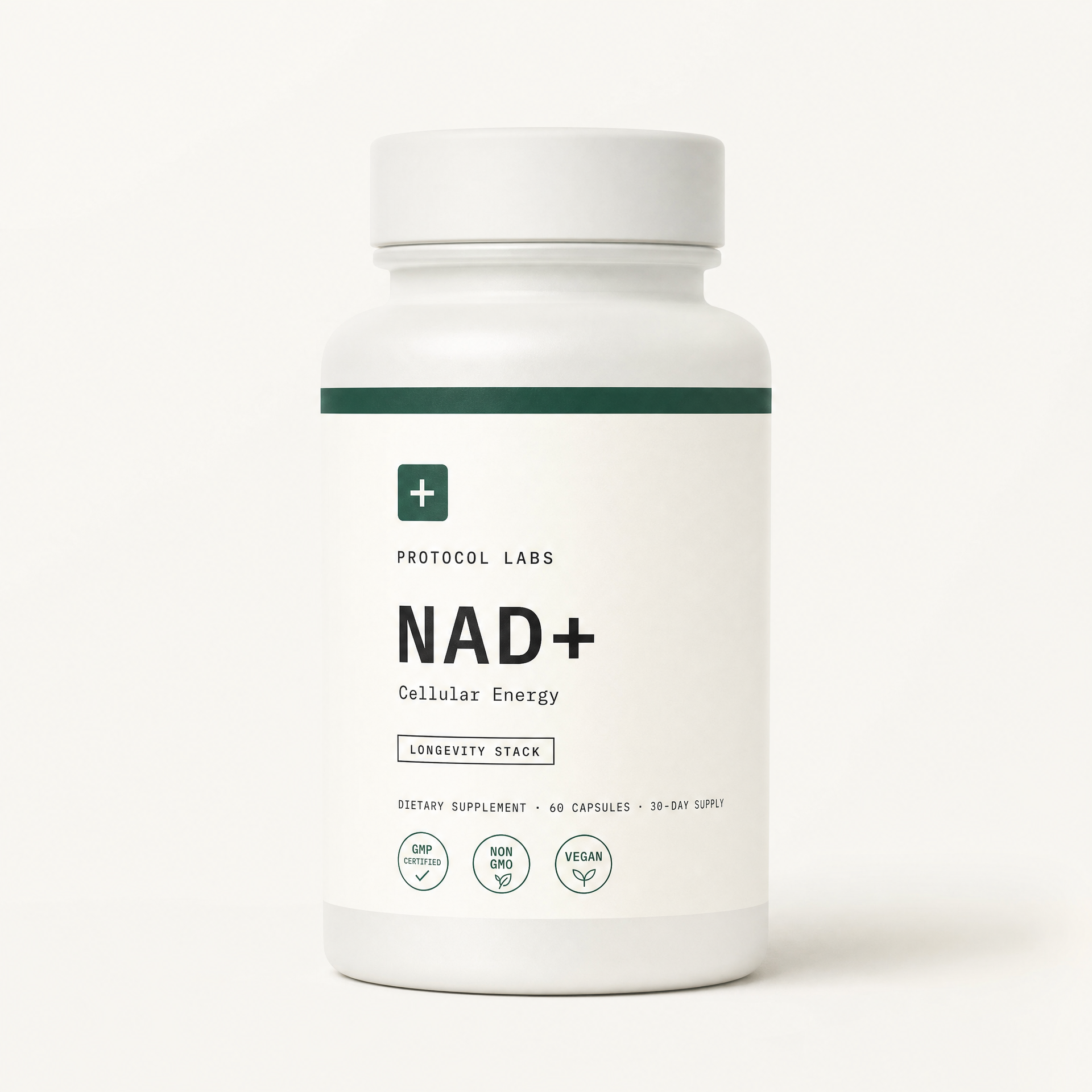
NAD+ with quercetin and resveratrol for cellular energy and longevity support.
Who it’s for
Adults looking for daily nad+ support as part of a consistent supplement routine.
Key ingredients
NAD+

NAD+

GMP
  • NAD+ with quercetin and resveratrol for cellular energy and longevity support.
  • DIETARY SUPPLEMENT · 60 CAPSULES · 30-DAY SUPPLY

$46.99

NAD+ with quercetin and resveratrol for cellular energy and longevity support.

SKU: SUF-NAD Category:

About NAD+

NAD+ with quercetin and resveratrol for cellular energy and longevity support.

Formulated with ingredients studied for their role in daily wellness. See research highlights below.

Part of these protocols

This compound is included in curated Protocol Labs stacks — save when you subscribe to the full routine.

Supplement facts

Supplement Facts
Serving Size 2 Capsules
Servings Per Container 30
Amount per serving % Daily Value
NAD+ (Nicotinamide Adenine Dinucleotide) 500 mg
Quercetin Dihydrate Extract (Sophora japonica) (whole flower bud) 250 mg
Japanese Knotweed Extract (98% resveratrol) (Polygonum cuspidatum) (root) 150 mg

Other ingredients: HPMC (vegetable capsule), MCC (microcrystalline cellulose), brown rice flour, olive oil, silicon dioxide, magnesium stearate.

Package
60 capsules / 1.8 oz / 0.11 lb / 50 g
Net weight
2.4 oz / 0.15 lbs / 68 g
Supply
DIETARY SUPPLEMENT · 60 CAPSULES · 30-DAY SUPPLY

How to use

As a dietary supplement, adults take two (2) capsules daily. For best results, take with 6 oz (177 ml) of water or as directed by healthcare professional.

Full ingredient list

NAD+ (Nicotinamide Adenine Dinucleotide) (500 mg), Quercetin Dihydrate Extract (Sophora japonica) (whole flower bud) (250 mg), Japanese Knotweed Extract (98% Resveratrol) (Polygonum cuspidatum) (root) (150 mg), HPMC (vegetable capsule), Microcrystalline Cellulose (MCC), Brown Rice Flour, Olive Oil, Silicon Dioxide, Magnesium Stearate.
Warnings & storage
Do not exceed recommended dose. Pregnant or nursing mothers, children under the age of 18, and individuals with a known medical condition should consult a physician before using this or any dietary supplement. Keep out of reach of children. Do not use if safety seal is damaged or missing. Store in a cool, dry place.
Quality & fulfillment
  • GMP — verified on label
  • Ships from GMP-certified U.S. fulfillment partners
  • Private Protocol Labs label art applied at fulfillment

Research highlights

Published studies on key ingredients in this formula. Not intended as medical advice.

Chronic NR Supplementation Is Well-Tolerated and Elevates NAD⁺ in Middle-Aged and Older Adults

This randomized, double-blind, placebo-controlled crossover trial (n=30, aged 55–79 years) administered 1000 mg/day of NR for 6 weeks. NR supplementation elevated blood cellular NAD+ concentrations by approximately 60% compared to placebo, and also produced a nearly fivefold increase in NAAD — a sensitive biomarker of enhanced NAD+ metabolism. No serious adverse events occurred, and all standard clinical laboratory markers remained within normal ranges. Exploratory analyses suggested a trend toward reduced systolic blood pressure (approximately 9 mmHg) and reduced aortic stiffness in participants with above-normal baseline blood pressure, identifying cardiovascular function as a priority endpoint for future larger-scale trials.

View source

NR Augments the Aged Human Skeletal Muscle NAD⁺ Metabolome and Induces Anti-Inflammatory Signatures

This 21-day, randomized, double-blind, placebo-controlled crossover trial (n=12 men, median age 75 years) administered 1000 mg/day of NR and confirmed that oral NR is bioavailable to human skeletal muscle — a previously open question. NR produced a twofold increase in the muscle NAD+ metabolome marker NAAD and a greater than twofold increase in blood NAD+ levels, alongside a fivefold elevation in NAM methylation clearance products, indicating substantial NAD+ pathway activation. Notably, NR significantly reduced circulating levels of pro-inflammatory cytokines IL-2, IL-5, IL-6, and TNF-α — suggesting meaningful anti-inflammatory effects relevant to aging. No changes in mitochondrial bioenergetics, grip strength, or cardiometabolic parameters were observed after 21 days, suggesting that functional muscle benefits may require longer intervention durations or populations with greater baseline NAD+ deficiency.

View source

Isoquercetin for Thromboinflammation in Sickle Cell Disease: A Randomized, Double-Blind, Placebo-Controlled Trial

This phase 2 RCT (n=46) tested isoquercetin — the orally bioavailable glucoside form of quercetin — at 1000 mg/day for 28–35 days in adults with sickle cell disease. While the primary endpoint (reduction in plasma P-selectin, a platelet activation marker) was not met, the trial demonstrated that isoquercetin significantly reduced whole-blood coagulability, attenuated collagen-induced platelet aggregation, inhibited plasma protein disulfide isomerase reductase activity (a key procoagulant regulator), and suppressed inducible tissue factor gene expression in peripheral blood mononuclear cells. The compound was safe, well-tolerated, and produced no off-target bleeding — confirming quercetin's anti-thromboinflammatory biological activity in humans, while also indicating that higher doses and longer treatment durations may be needed to demonstrate significant primary endpoint effects.

View source

Resveratrol for Alzheimer's Disease: A Phase II Randomized, Double-Blind, Placebo-Controlled Trial

This 52-week, phase II RCT (n=119) tested escalating doses of synthetic resveratrol (up to 2000 mg/day) in adults with mild-to-moderate Alzheimer's disease. Despite the challenging bioavailability of oral resveratrol, the compound was detectable in cerebrospinal fluid and was confirmed safe and well-tolerated at high doses. Notably, resveratrol stabilized cerebrospinal fluid and plasma levels of amyloid-β40 — a key Alzheimer's pathology marker — which declined significantly in the placebo group; additionally, resveratrol reduced CSF matrix metalloproteinase-9 by approximately 50%, suggesting preserved blood-brain barrier integrity and reduced neuroinflammation. While no statistically significant effects were seen on cognitive outcome measures, the study established key proof-of-concept regarding resveratrol's mechanistic engagement with SIRT1-linked aging pathways and its central nervous system anti-inflammatory activity.

View source

Resveratrol Improves Bone Mineral Density in Postmenopausal Women: The RESHAW Trial

The RESHAW trial was a 24-month randomized, double-blind, placebo-controlled, two-period crossover study examining resveratrol at 75 mg twice daily (150 mg/day — closely matching your supplement's dose) in postmenopausal women. After 12 months, resveratrol supplementation significantly increased bone mineral density at the lumbar spine and femoral neck, accompanied by a 7.24% reduction in C-terminal telopeptide type-1 collagen — an established bone resorption biomarker — compared with placebo. The improvement in femoral neck bone density correlated with improved regional bone perfusion, suggesting a vascular mechanism underlying resveratrol's bone-protective effects. The bone-protective effect was particularly pronounced in participants with poorer baseline bone health and in those co-supplementing with vitamin D and calcium.

View source

Resveratrol Improves Memory Performance and Hippocampal Function in Healthy Older Adults

This 26-week, matched placebo-controlled trial (n=46 healthy overweight adults aged 50–75) tested resveratrol at 200 mg/day — close to your supplement's 150 mg dose. Resveratrol significantly improved retention of words over a 30-minute delay compared to placebo (p=0.038), and increased hippocampal functional connectivity between the left posterior hippocampus and medial prefrontal cortex, a network implicated in memory consolidation. Resveratrol also produced significant reductions in HbA1c (a marker of long-term blood glucose regulation) and body fat, and increased leptin levels. The improvements in memory correlated with both the improvements in hippocampal connectivity and the reductions in HbA1c, suggesting that resveratrol's cognitive benefit may be partly mediated through improved glucose metabolism. This is one of the few RCTs demonstrating a direct cognitive benefit of resveratrol in humans.

View source

Common questions

How should I take NAD+?

As a dietary supplement, adults take two (2) capsules daily. For best results, take with 6 oz (177 ml) of water or as directed by healthcare professional.

Can I pair this with a Protocol Labs stack?

Yes. This compound is available standalone or as part of curated protocol stacks. Check the "Part of these protocols" section for bundles that include it.

Where is this manufactured?

Protocol Labs products are fulfilled from GMP-certified U.S. facilities via vetted dropship partners. Each bottle ships with a printed supplement facts panel matching the formula listed on this page.

What is NAD+ used for?

NAD+ with quercetin and resveratrol for cellular energy and longevity support. Consult your healthcare provider before use, especially if pregnant, nursing, or taking medications.

Is NAD+ FDA approved?

No. NAD+ is a dietary supplement, not an FDA-approved drug. It is not intended to diagnose, treat, cure, or prevent any disease.

Does Protocol Labs offer subscribe-and-save on NAD+?

Subscribe-and-save is available on protocol stacks. Standalone compounds like NAD+ are typically sold as one-time purchases on protocollab.store.

These statements have not been evaluated by the Food and Drug Administration. This product is not intended to diagnose, treat, cure, or prevent any disease.

NAD+ with quercetin and resveratrol for cellular energy and longevity support.

Formulated with ingredients studied for their role in daily wellness. See research highlights below.

Key ingredients

NAD+ (Nicotinamide Adenine Dinucleotide) (500 mg), Quercetin Dihydrate Extract (Sophora japonica) (whole flower bud) (250 mg), Japanese Knotweed Extract (98% Resveratrol) (Polygonum cuspidatum) (root) (150 mg), HPMC (vegetable capsule), Microcrystalline Cellulose (MCC), Brown Rice Flour, Olive Oil, Silicon Dioxide, Magnesium Stearate.
Supplement Facts
Serving Size 2 Capsules
Servings Per Container 30
Amount per serving % Daily Value
NAD+ (Nicotinamide Adenine Dinucleotide) 500 mg
Quercetin Dihydrate Extract (Sophora japonica) (whole flower bud) 250 mg
Japanese Knotweed Extract (98% resveratrol) (Polygonum cuspidatum) (root) 150 mg

Other ingredients: HPMC (vegetable capsule), MCC (microcrystalline cellulose), brown rice flour, olive oil, silicon dioxide, magnesium stearate.

Chronic NR Supplementation Is Well-Tolerated and Elevates NAD⁺ in Middle-Aged and Older Adults

This randomized, double-blind, placebo-controlled crossover trial (n=30, aged 55–79 years) administered 1000 mg/day of NR for 6 weeks. NR supplementation elevated blood cellular NAD+ concentrations by approximately 60% compared to placebo, and also produced a nearly fivefold increase in NAAD — a sensitive biomarker of enhanced NAD+ metabolism. No serious adverse events occurred, and all standard clinical laboratory markers remained within normal ranges. Exploratory analyses suggested a trend toward reduced systolic blood pressure (approximately 9 mmHg) and reduced aortic stiffness in participants with above-normal baseline blood pressure, identifying cardiovascular function as a priority endpoint for future larger-scale trials.

View source

NR Augments the Aged Human Skeletal Muscle NAD⁺ Metabolome and Induces Anti-Inflammatory Signatures

This 21-day, randomized, double-blind, placebo-controlled crossover trial (n=12 men, median age 75 years) administered 1000 mg/day of NR and confirmed that oral NR is bioavailable to human skeletal muscle — a previously open question. NR produced a twofold increase in the muscle NAD+ metabolome marker NAAD and a greater than twofold increase in blood NAD+ levels, alongside a fivefold elevation in NAM methylation clearance products, indicating substantial NAD+ pathway activation. Notably, NR significantly reduced circulating levels of pro-inflammatory cytokines IL-2, IL-5, IL-6, and TNF-α — suggesting meaningful anti-inflammatory effects relevant to aging. No changes in mitochondrial bioenergetics, grip strength, or cardiometabolic parameters were observed after 21 days, suggesting that functional muscle benefits may require longer intervention durations or populations with greater baseline NAD+ deficiency.

View source

Isoquercetin for Thromboinflammation in Sickle Cell Disease: A Randomized, Double-Blind, Placebo-Controlled Trial

This phase 2 RCT (n=46) tested isoquercetin — the orally bioavailable glucoside form of quercetin — at 1000 mg/day for 28–35 days in adults with sickle cell disease. While the primary endpoint (reduction in plasma P-selectin, a platelet activation marker) was not met, the trial demonstrated that isoquercetin significantly reduced whole-blood coagulability, attenuated collagen-induced platelet aggregation, inhibited plasma protein disulfide isomerase reductase activity (a key procoagulant regulator), and suppressed inducible tissue factor gene expression in peripheral blood mononuclear cells. The compound was safe, well-tolerated, and produced no off-target bleeding — confirming quercetin's anti-thromboinflammatory biological activity in humans, while also indicating that higher doses and longer treatment durations may be needed to demonstrate significant primary endpoint effects.

View source

Resveratrol for Alzheimer's Disease: A Phase II Randomized, Double-Blind, Placebo-Controlled Trial

This 52-week, phase II RCT (n=119) tested escalating doses of synthetic resveratrol (up to 2000 mg/day) in adults with mild-to-moderate Alzheimer's disease. Despite the challenging bioavailability of oral resveratrol, the compound was detectable in cerebrospinal fluid and was confirmed safe and well-tolerated at high doses. Notably, resveratrol stabilized cerebrospinal fluid and plasma levels of amyloid-β40 — a key Alzheimer's pathology marker — which declined significantly in the placebo group; additionally, resveratrol reduced CSF matrix metalloproteinase-9 by approximately 50%, suggesting preserved blood-brain barrier integrity and reduced neuroinflammation. While no statistically significant effects were seen on cognitive outcome measures, the study established key proof-of-concept regarding resveratrol's mechanistic engagement with SIRT1-linked aging pathways and its central nervous system anti-inflammatory activity.

View source

Resveratrol Improves Bone Mineral Density in Postmenopausal Women: The RESHAW Trial

The RESHAW trial was a 24-month randomized, double-blind, placebo-controlled, two-period crossover study examining resveratrol at 75 mg twice daily (150 mg/day — closely matching your supplement's dose) in postmenopausal women. After 12 months, resveratrol supplementation significantly increased bone mineral density at the lumbar spine and femoral neck, accompanied by a 7.24% reduction in C-terminal telopeptide type-1 collagen — an established bone resorption biomarker — compared with placebo. The improvement in femoral neck bone density correlated with improved regional bone perfusion, suggesting a vascular mechanism underlying resveratrol's bone-protective effects. The bone-protective effect was particularly pronounced in participants with poorer baseline bone health and in those co-supplementing with vitamin D and calcium.

View source

Resveratrol Improves Memory Performance and Hippocampal Function in Healthy Older Adults

This 26-week, matched placebo-controlled trial (n=46 healthy overweight adults aged 50–75) tested resveratrol at 200 mg/day — close to your supplement's 150 mg dose. Resveratrol significantly improved retention of words over a 30-minute delay compared to placebo (p=0.038), and increased hippocampal functional connectivity between the left posterior hippocampus and medial prefrontal cortex, a network implicated in memory consolidation. Resveratrol also produced significant reductions in HbA1c (a marker of long-term blood glucose regulation) and body fat, and increased leptin levels. The improvements in memory correlated with both the improvements in hippocampal connectivity and the reductions in HbA1c, suggesting that resveratrol's cognitive benefit may be partly mediated through improved glucose metabolism. This is one of the few RCTs demonstrating a direct cognitive benefit of resveratrol in humans.

View source

Reviews

There are no reviews yet.

Be the first to review “NAD+”

Your email address will not be published. Required fields are marked *

NAD+ $46.99